

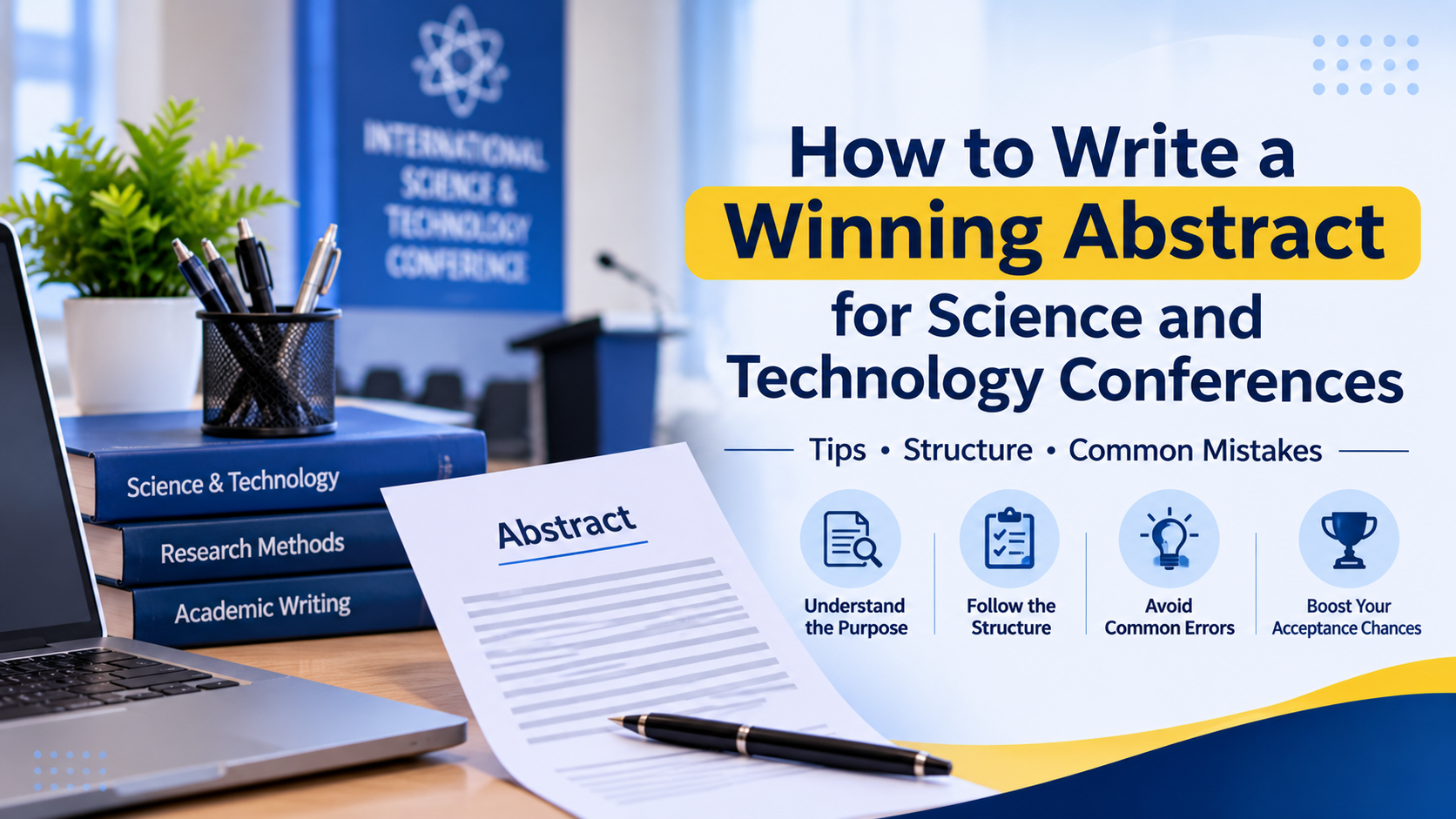
How to Write a Winning Abstract for Science and Technology Conferences
Submitting a research abstract is one of the first important steps towards presenting your work at an academic conference. Whether you are an undergraduate student, PhD scholar, engineer, scientist, or experienced researcher, a well-written abstract can help communicate the value of your research to conference organisers and reviewers.
International science and technology conferences bring together researchers from different academic disciplines to share discoveries, discuss emerging technologies, and explore innovative solutions to scientific and engineering challenges. However, before researchers can present their work, they often need to submit an abstract for evaluation.
An abstract is a concise summary of a research paper or proposed study. It provides reviewers with an overview of the research problem, objectives, methodology, findings, and significance. Since reviewers may receive hundreds of submissions, an effective abstract should communicate the main research contribution clearly and efficiently.
Writing a strong research abstract requires more than summarising a paper. Researchers must identify the most important information, organise their ideas logically, use precise academic language, and follow the conference submission guidelines.
In this article, we explain how to write a winning abstract for science and technology conferences, highlight common mistakes to avoid, and provide practical tips to improve your chances of successful abstract submission.
1. Understand the Purpose of a Research Abstract
A research abstract is a short overview of an academic study. Its primary purpose is to help readers and reviewers understand what the research investigates, how it was conducted, and why its findings are important.
At an international conference, abstracts are commonly used to evaluate submissions and determine whether research is suitable for presentation in oral or poster sessions.
A good abstract should answer five important questions:
- What research problem are you addressing?
- Why is the research important?
- What objectives does the study aim to achieve?
- What methodology or approach did you use?
- What are the main findings or expected contributions?
For example, an abstract about artificial intelligence in healthcare should explain the specific healthcare problem being investigated, the AI technique used, the research methodology, and the significance of the findings.
Similarly, an engineering research abstract should clearly describe the technical challenge, experimental approach, results, and practical applications.
The objective is to provide enough information for reviewers to understand the research without requiring them to read the complete paper.
2. Understand the Different Types of Research Abstracts
Before writing your abstract, identify which type is required by the conference.
Different academic events may request different abstract formats depending on their research disciplines and submission procedures.
Descriptive Abstract
A descriptive abstract provides a brief overview of the research topic, objectives, and general scope of the study.
It usually does not include detailed experimental findings or conclusions.
This format is sometimes used for theoretical studies, research proposals, and preliminary investigations.
Informative Abstract
An informative abstract provides a more complete summary of the research.
It generally includes:
- Research background.
- Problem statement.
- Research objectives.
- Methodology.
- Major findings.
- Conclusion and significance.
This is a common format for completed scientific and technical research.
Structured Abstract
A structured abstract divides information into clearly labelled sections.
Common headings include Background, Objectives, Methods, Results, and Conclusion.
This format helps reviewers identify important research information quickly and is frequently used in scientific and medical publications.
Always follow the specific abstract format requested by your selected conference.
3. Follow the Standard Structure of a Strong Research Abstract
A well-organised abstract should present information in a logical sequence.
Although word limits vary, many academic conferences request abstracts between 150 and 300 words. Some events may accept longer submissions depending on their guidelines.
The following structure can help researchers prepare a clear and effective abstract.
Background and Introduction
Begin by introducing the research topic and explaining why it matters.
Provide sufficient context to help reviewers understand the subject without including an extensive literature review.
For example:
"Renewable energy technologies are becoming increasingly important for reducing dependence on conventional energy sources. However, improving the efficiency and reliability of solar energy systems remains an important engineering challenge."
This introduction establishes the research context and identifies the broader issue.
Research Problem
Clearly identify the specific problem your study addresses.
Avoid describing a broad scientific challenge without explaining the particular issue investigated in your research.
For example, instead of stating that artificial intelligence is transforming healthcare, explain which diagnostic, prediction, or data-analysis challenge your study aims to address.
Research Objectives
Explain what your research intends to investigate, develop, evaluate, or demonstrate.
Use clear action-oriented language such as:
- To investigate...
- To evaluate...
- To develop...
- To compare...
- To analyse...
- To demonstrate...
Your objectives should directly relate to the research problem.
Research Methodology
Briefly explain how the research was conducted.
Depending on your discipline, this may include experimental procedures, computational models, statistical analysis, simulation techniques, laboratory testing, surveys, or case studies.
Mention the most important tools, techniques, datasets, or experimental conditions where relevant.
Results and Key Findings
This is one of the most important sections of an informative research abstract.
Present the main findings using clear and accurate statements.
Where appropriate, include important numerical results, performance improvements, statistical observations, or experimental outcomes.
Avoid making unsupported claims or presenting expected results as completed findings.
If your work is still in progress, clearly describe the expected outcomes only when the conference permits preliminary or proposed research submissions.
Conclusion and Research Significance
Finish by explaining what the findings mean and why they matter.
Highlight the research contribution, potential applications, or implications for future scientific and technological developments.
A strong conclusion should leave reviewers with a clear understanding of the value of your study.
4. Write a Clear and Relevant Research Title
Your research title is often the first thing conference reviewers notice.
A good title should accurately describe the research topic and communicate its main focus.
Consider these recommendations:
Be Specific: Avoid titles that are too broad or vague. Identify the technology, method, application, or research problem wherever appropriate.
Use Relevant Keywords: Include important technical terms that describe your research area.
Keep It Concise: Avoid unnecessary words and lengthy explanations.
Maintain Accuracy: Your title should reflect the actual scope and findings of your research.
For example:
General title: "Artificial Intelligence in Technology"
More specific title: "Machine Learning-Based Energy Consumption Prediction for Smart Building Systems"
The second title provides a clearer indication of the research subject and technical contribution.
5. Use Technical Keywords Effectively
Keywords help conference organisers, academic databases, and researchers understand the subject area of your work.
They also make your research easier to discover through academic search platforms.
Select approximately three to six relevant keywords, depending on the conference guidelines.
For example, an abstract about renewable energy forecasting might use:
- Renewable Energy
- Solar Power
- Machine Learning
- Energy Forecasting
- Predictive Modelling
For a cybersecurity research paper, relevant keywords might include:
- Cybersecurity
- Network Security
- Intrusion Detection
- Artificial Intelligence
- Threat Analysis
Choose keywords that accurately represent your research rather than adding unrelated popular terms.
6. Make Your Abstract Easy to Read and Understand
A technically strong abstract may lose its effectiveness if the language is confusing or unnecessarily complicated.
Remember that international conferences often attract researchers from different academic backgrounds. Your abstract should communicate your research clearly, even when the subject involves specialised technical concepts.
Follow these writing practices:
- Use short and meaningful sentences.
- Avoid unnecessary technical jargon.
- Explain specialised terminology when needed.
- Maintain a logical flow between ideas.
- Use active voice where appropriate.
- Remove repetitive statements.
- Check grammar, spelling, and punctuation.
Every sentence should contribute useful information.
Avoid filling the abstract with general statements about the importance of science or technology. Focus on the specific research problem, methods, findings, and contribution.
7. Common Mistakes to Avoid When Writing a Conference Abstract
Many researchers make avoidable mistakes when preparing their abstracts.
Understanding these issues can improve the quality of your submission.
Writing an Abstract That Is Too General
A vague abstract does not communicate the actual research contribution.
Instead of making broad statements, explain the specific problem and what your research investigates.
Ignoring the Word Limit
Conference organisers usually specify a maximum or minimum word count.
An abstract that does not meet the submission requirements may be returned or rejected during the initial screening process.
Always check the official guidelines before submitting.
Missing Research Findings
For completed research, failing to mention the main findings makes it difficult for reviewers to evaluate the study's contribution.
Include relevant results whenever available and permitted by the conference format.
Including Too Much Background Information
The abstract is not a complete literature review.
Keep the background concise and dedicate sufficient space to your objectives, methodology, findings, and conclusions.
Using Unsupported Claims
Avoid statements such as "This research completely solves the problem" unless your findings genuinely support such a conclusion.
Academic writing should remain objective and evidence-based.
Adding Unnecessary References
Many conference abstracts do not require citations.
Do not include references unless the conference submission guidelines specifically request them.
Failing to Proofread
Grammar errors, inconsistent terminology, and unclear sentences can affect the readability and professionalism of your abstract.
Review your work carefully before submission.
8. Practical Tips to Improve Your Chances of Abstract Acceptance
Writing a strong abstract does not guarantee acceptance, as the final decision depends on the conference's review criteria, available presentation slots, and research quality.
However, the following practices can help improve your submission.
Read the Conference Guidelines: Review the submission requirements, research themes, word limits, formatting rules, and evaluation criteria.
Match Your Research to the Conference Theme: Select an event that aligns with your subject area and research objectives.
Highlight Your Original Contribution: Explain what makes your research relevant or different from existing studies.
Present Results Clearly: Include accurate findings and measurable outcomes whenever possible.
Use Appropriate Academic Language: Maintain a professional tone and avoid informal expressions.
Request Feedback: Ask your research supervisor, colleagues, or experienced researchers to review your abstract before submission.
Submit Before the Deadline: Avoid last-minute submissions and allow enough time for corrections.
Check Submission Details: Ensure that author names, affiliations, email addresses, keywords, and other required information are accurate.
A carefully prepared submission demonstrates professionalism and respect for the academic review process.
9. What Happens After You Submit Your Research Abstract?
After submission, the abstract generally goes through an evaluation process conducted by conference organisers, editors, or subject experts.
Although procedures differ between conferences, the process commonly involves the following stages.
Initial Screening
The organising team checks whether the abstract follows submission guidelines and fits the conference's research themes.
Academic Review
Qualified reviewers may evaluate the research's relevance, originality, clarity, methodology, and potential contribution.
Acceptance Decision
The conference communicates whether the abstract has been accepted, rejected, or requires further clarification or revision.
Presentation Preparation
Accepted researchers receive instructions about preparing their oral or poster presentations.
Conference Participation
Researchers present their work, discuss findings, answer questions, and interact with other participants.
It is important to remember that abstract acceptance and full research paper acceptance are not always the same. Some conferences require a separate full-paper submission and review process.
Researchers should carefully review the event's publication and presentation policies.
10. Present Your Research at International Science and Technology Conferences
Writing a strong abstract is an important first step towards participating in international academic events.
Conference participation provides researchers with opportunities to present their findings, receive expert feedback, explore emerging technologies, and build professional relationships.
For young scientists, postgraduate students, and engineering researchers, these events can also improve academic communication and presentation skills.
The Scientific and Technical Research Association (STRA) provides a platform for researchers, academicians, and professionals to explore international science and technology conferences across different research disciplines.
Through academic events and research discussions, participants can share their work, learn from other researchers, and become more connected with the global scientific community.
Researchers interested in participating should explore relevant conference announcements, submission deadlines, research themes, and abstract guidelines through the official STRA website.
Conclusion
Writing a winning abstract for a science and technology conference requires clarity, accuracy, and a strong understanding of your research contribution.
From selecting an appropriate title and explaining the research problem to describing the methodology and presenting important findings, every part of the abstract should serve a clear purpose.
Researchers should also follow conference submission guidelines, use relevant technical keywords, maintain professional academic language, and carefully proofread their work before submission.
A well-written abstract helps reviewers understand the value of your research and provides an important opportunity to introduce your work to the international academic community.
For students, scientists, engineers, and experienced researchers, conference participation can become a valuable part of academic and professional development.
Through platforms such as the Scientific and Technical Research Association (STRA), researchers can explore opportunities to present their findings, exchange scientific knowledge, and connect with professionals from different parts of the world.
Start with a clear research idea, communicate your findings effectively, and take the next step towards sharing your work at an international science and technology conference.
Frequently Asked Questions (FAQs)
1. What is a research abstract?
A research abstract is a concise summary of an academic study that explains its background, objectives, methodology, key findings, and conclusion.
2. How many words should a conference abstract contain?
Many academic conferences request abstracts between 150 and 300 words. However, the exact word limit depends on the conference's submission guidelines.
3. What should be included in a scientific abstract?
A scientific abstract generally includes the research background, problem statement, objectives, methodology, major findings, and conclusion.
4. How do I write a good abstract for an international conference?
Choose a clear title, explain your research problem, describe your methodology, highlight important findings, and explain the significance of your work. Follow the conference guidelines and proofread before submission.
5. Can I submit an abstract without completing my research?
Some conferences accept preliminary research or research proposals, while others require completed studies with actual findings. Always check the submission requirements before applying.
6. What are keywords in a research abstract?
Keywords are important terms that describe the main subject, methodology, or research area. They help readers and academic platforms identify relevant research.
7. What is the difference between an abstract and a full research paper?
An abstract is a short summary of a study, whereas a full research paper provides detailed information about the background, literature review, methodology, results, discussion, and references.
8. Can an abstract be rejected by a conference?
Yes. Abstracts may be rejected if they do not match the conference theme, lack sufficient research contribution, contain unclear information, or fail to meet submission requirements.
9. Should I include references in a conference abstract?
Most conferences do not require references in abstracts, but some may request them. Follow the official submission instructions.
10. Why should researchers present abstracts at international conferences?
Presenting research at international conferences helps researchers share their findings, receive expert feedback, improve communication skills, and establish academic connections with the global research community.
