


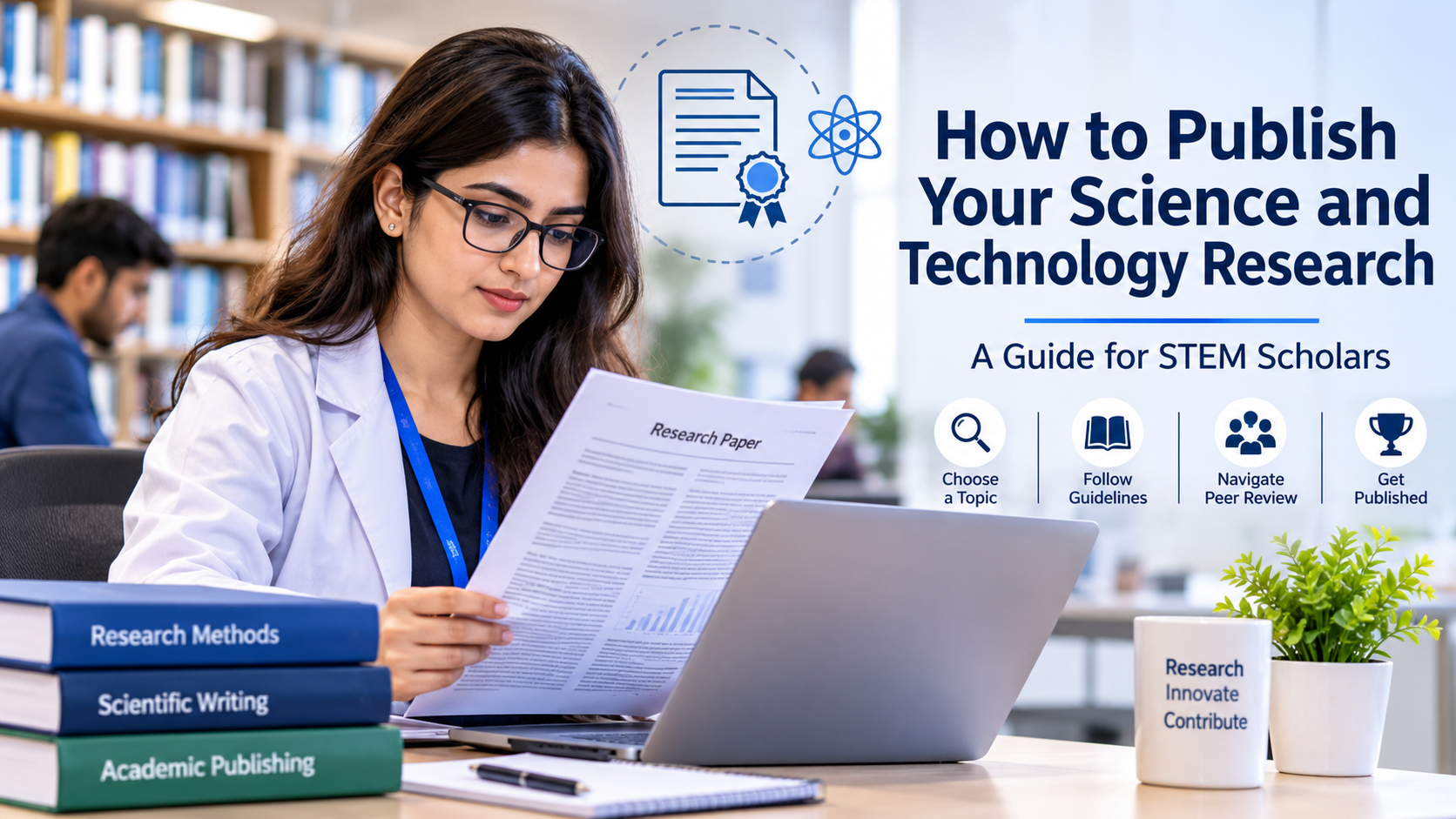
How to Publish Your Science and Technology Research: A Guide for STEM Scholars
Publishing scientific and technological research is an important milestone in an academic or professional research career. It allows researchers to share their discoveries, contribute to existing knowledge, and communicate innovative ideas with the global scientific community.
For students, PhD scholars, engineers, academicians, and STEM professionals, publishing a research paper can open doors to academic recognition, international collaborations, research opportunities, and professional development.
However, publishing research is not always straightforward. Researchers must identify a suitable journal or conference, prepare a well-structured manuscript, follow publication guidelines, complete the peer-review process, and address reviewers' comments.
Whether you are preparing your first research paper or looking to improve your publication record, understanding the research publication process can make the journey easier.
In this guide, we explain how to publish science and technology research, from selecting a research topic to getting your paper published in a suitable academic journal or conference proceeding.
1. Understand the Importance of Publishing Scientific Research
Research publication plays a significant role in advancing science, engineering, and technology. It provides a platform for researchers to present their findings, explain their methodologies, and contribute evidence-based knowledge to their respective fields.
Some important benefits of publishing research include:
Academic Recognition: Published research helps establish a researcher's academic profile and demonstrates their contribution to a particular subject area.
Knowledge Sharing: Research publications allow scientists and engineers to share discoveries, experimental results, and innovative approaches with researchers worldwide.
Career Development: A strong publication record can support applications for research positions, academic opportunities, fellowships, and doctoral programmes.
International Collaboration: Publishing research increases opportunities to connect with researchers working on similar topics across different institutions and countries.
Research Impact: Well-conducted research can help address existing scientific challenges, improve technologies, and support further innovation.
For these reasons, research publication is an important part of academic development for students, early-career researchers, and experienced professionals.
2. Choose a Relevant Science and Technology Research Topic
The first step towards publishing a research paper is selecting a relevant and researchable topic.
A good research topic should address a specific problem, explore an existing research gap, or introduce a new approach to an established challenge.
Researchers should consider the following factors when selecting a topic:
- Personal academic interests and subject expertise.
- Current developments in science and technology.
- Unanswered questions in existing research.
- Availability of research materials, equipment, and data.
- Practical applications and potential research contributions.
- Relevance to the selected academic discipline.
For example, researchers in computer science may explore artificial intelligence, machine learning, cybersecurity, cloud computing, or data science.
Mechanical and electrical engineering researchers may investigate renewable energy systems, robotics, automation, advanced materials, or energy-efficient technologies.
Similarly, researchers in applied sciences may focus on environmental sustainability, biotechnology, nanotechnology, and materials science.
The most important consideration is to identify a topic that allows you to conduct meaningful research and produce reliable findings.
3. Conduct a Comprehensive Literature Review
Before conducting experiments or writing a manuscript, researchers should review existing academic literature related to their chosen topic.
A literature review helps researchers understand what has already been studied, which methodologies have been used, and where further investigation may be required.
Useful sources for academic literature include:
- Google Scholar
- IEEE Xplore
- ScienceDirect
- SpringerLink
- PubMed
- ACM Digital Library
- Web of Science
While reviewing previous publications, pay attention to research objectives, methodologies, findings, limitations, and recommendations for future research.
Identify areas where existing studies provide incomplete answers or where new techniques could improve previous results.
A strong literature review helps establish the foundation of your research and demonstrates how your work relates to existing scientific knowledge.
Researchers should also maintain proper records of all references to avoid accidental plagiarism and citation errors.
4. Design Your Research Methodology
Research methodology explains how you conducted your study and how you obtained your findings.
It is one of the most important sections of a scientific or technical research paper because it allows other researchers to understand and evaluate your work.
Depending on the research discipline, your methodology may involve:
Experimental Research: Conducting laboratory experiments, testing materials, measuring performance, or evaluating scientific processes.
Computational Research: Using simulations, algorithms, mathematical models, or computational tools to investigate a particular problem.
Survey-Based Research: Collecting information through questionnaires, interviews, or structured observations.
Data Analysis: Analysing datasets using statistical techniques, machine learning models, or other analytical approaches.
Case Study Research: Investigating a specific technology, engineering system, organisation, or real-world application.
Your methodology should clearly explain the research design, materials, tools, procedures, data collection methods, and analysis techniques.
Ensure that your findings are supported by reliable evidence and that your research follows relevant ethical and disciplinary standards.
5. Write a Well-Structured Research Paper
Once your research is complete, the next step is preparing a professional academic manuscript.
Although formatting requirements differ between journals and conferences, most scientific and technical research papers follow a common structure.
Title
The title should clearly communicate the subject of your research. Keep it concise, specific, and relevant to the main research contribution.
Abstract
The abstract provides a brief overview of the entire study. It generally includes the research problem, objectives, methodology, major findings, and conclusion.
Many journals and conferences specify an abstract length, commonly between 150 and 300 words.
Keywords
Include relevant keywords that describe your research topic, methodology, and subject area. These terms help readers discover your publication through academic search platforms.
Introduction
Introduce the research topic, explain the background, identify the problem, and describe the objectives of your study.
Literature Review
Discuss relevant previous studies and explain the research gap your work aims to address.
Research Methodology
Describe the methods, experimental procedures, tools, and techniques used to conduct the research.
Results and Discussion
Present your research findings using appropriate tables, graphs, figures, and statistical information. Explain what the results mean and how they relate to your research objectives.
Conclusion
Summarise the major findings, explain the contribution of your research, acknowledge relevant limitations, and suggest future research directions.
References
Include all sources cited in your manuscript using the referencing style required by the selected journal or conference.
A well-organised manuscript makes your research easier to understand and improves its overall academic presentation.
6. Select the Right Journal or International Conference
Selecting an appropriate publication platform is one of the most important decisions in the research publication process.
Researchers generally have two major options: academic journals and conference proceedings.
Academic Journals
Academic journals publish research articles in specific scientific, engineering, and technological disciplines.
They often follow a detailed peer-review process and may require substantial revisions before accepting a manuscript.
When selecting a journal, consider:
- Whether its scope matches your research.
- Its peer-review policies.
- Publication ethics and editorial standards.
- Publication fees, if applicable.
- Review timelines.
- Indexing and discoverability.
- Publisher reputation.
International Conference Proceedings
International academic conferences provide another opportunity to present and publish research.
Researchers submit papers for consideration, and accepted contributions may be presented through oral or poster sessions.
Depending on the conference, accepted papers may be published in conference proceedings.
Before submitting, carefully review the conference's publication information, submission requirements, review process, and any claims about indexing.
Organisations such as the Scientific and Technical Research Association (STRA) provide platforms for researchers and professionals to explore international science and technology conferences and engage with the wider research community.
Choosing the right publication platform depends on your research objectives, subject area, and publication requirements.
7. Understand the Peer-Review Process
Peer review is an important part of academic publishing. It involves evaluating submitted research manuscripts to assess their quality, originality, methodology, relevance, and contribution to the field.
During this process, journal editors or conference reviewers may evaluate your manuscript and provide recommendations.
Common peer-review outcomes include:
Accepted: The manuscript is approved for publication, sometimes with minor editorial changes.
Minor Revisions: The paper requires relatively small corrections before final acceptance.
Major Revisions: The researchers must address substantial concerns and submit a revised manuscript for further evaluation.
Rejected: The manuscript is not accepted for publication in its current form.
Receiving reviewer comments is a normal part of academic publishing. Even experienced researchers may need to revise their work several times.
When responding to reviewers, address every comment carefully, provide evidence where necessary, and explain any changes made to the manuscript.
If you disagree with a particular suggestion, respond respectfully and provide a clear academic justification.
8. Avoid Common Research Publication Mistakes
Many research papers face rejection because of avoidable problems related to manuscript preparation, research quality, or publication practices.
Researchers should pay attention to the following issues:
Plagiarism: Always use original writing and provide proper citations when referring to previously published work. Use plagiarism-checking tools where appropriate.
Weak Research Contribution: Clearly explain what your study adds to existing knowledge. A manuscript should demonstrate a meaningful research contribution.
Poor Manuscript Structure: Organise your paper logically and follow the journal's or conference's formatting requirements.
Inadequate References: Use relevant and credible academic sources. Ensure that all cited works are included in the reference list.
Unsupported Conclusions: Do not make claims that go beyond the evidence provided by your research.
Ignoring Submission Guidelines: Check formatting, word limits, figure requirements, reference styles, and other submission instructions before uploading your manuscript.
Predatory Publishing Practices: Be cautious of publishers or conferences that promise guaranteed acceptance, lack transparent peer-review policies, or make misleading indexing claims.
Researchers should prioritise publication quality, academic integrity, and the credibility of the publishing organisation rather than focusing only on publication speed.
9. Improve Your Chances of Getting Research Published
Although no publication strategy can guarantee acceptance, researchers can improve their manuscripts through careful preparation and academic discipline.
Here are some practical recommendations:
- Choose a focused and relevant research problem.
- Conduct a detailed literature review.
- Use reliable research methods and accurate data.
- Explain your research contribution clearly.
- Follow the selected journal's or conference's guidelines.
- Check grammar, technical terminology, and formatting.
- Ask experienced researchers or supervisors to review your manuscript.
- Address reviewer comments professionally.
- Maintain transparency in data collection and reporting.
- Select a publication platform that matches your research scope.
Researchers should also keep learning about developments in their fields by attending academic events, participating in technical discussions, and reading recently published research.
10. Build Your Global Academic Research Profile
Publishing a research paper is not the end of the research journey. Researchers should also work towards building a professional academic profile that makes their work accessible to the wider research community.
Some useful platforms and practices include:
ORCID: Create an ORCID identifier to establish a persistent digital identity for your research activities.
Google Scholar Profile: Maintain a Google Scholar profile to organise your publications and monitor citations where available.
ResearchGate: Connect with other researchers and share eligible research outputs through an academic networking platform.
LinkedIn: Use LinkedIn to communicate research achievements, academic interests, and professional developments.
Academic Conferences: Participate in international conferences, workshops, and research discussions to increase academic visibility and build professional relationships.
Researchers should keep their profiles updated and ensure that publication information is accurate.
Over time, a combination of quality publications, conference participation, and meaningful academic collaborations can strengthen a researcher's professional reputation.
Conclusion
Publishing science and technology research is an important step towards contributing to global academic knowledge and advancing scientific innovation.
From selecting a research topic and conducting a literature review to preparing a manuscript, choosing a suitable journal, and completing the peer-review process, every stage requires careful planning and attention to detail.
For students, PhD scholars, engineers, and experienced researchers, the publication journey provides valuable opportunities to develop academic skills, share discoveries, receive expert feedback, and establish international research connections.
Researchers should always prioritise originality, ethical research practices, reliable findings, and reputable publication platforms.
Participating in international academic conferences can further support this journey by providing opportunities to present research, exchange ideas, and connect with professionals from different scientific and technological disciplines.
Through platforms such as the Scientific and Technical Research Association (STRA), researchers can explore international academic events and become part of a wider community dedicated to scientific research, technological advancement, and knowledge sharing.
Start with a meaningful research question, develop your findings carefully, and take the next step towards sharing your work with the global research community.
Frequently Asked Questions (FAQs)
1. How can I publish my science and technology research paper?
Start by selecting a research topic, conducting a literature review, completing your research, and preparing a manuscript. Identify a suitable journal or conference, follow its submission guidelines, and complete the peer-review process.
2. Can students publish research papers?
Yes. Undergraduate students, postgraduate students, and PhD scholars can publish research papers if their work meets the academic and publication requirements of the selected journal or conference.
3. What is the difference between a journal and conference publication?
A journal generally publishes research articles through an editorial and peer-review process, while a conference publication is associated with an academic event where accepted research may be presented and published in proceedings. Their review processes and publication requirements vary.
4. How long does it take to publish a research paper?
Publication timelines vary depending on the journal, conference, review process, and revision requirements. Some conference proceedings have relatively short timelines, while journal publication can take several months or longer.
5. What is peer review in academic publishing?
Peer review is an evaluation process in which qualified researchers or subject experts assess a submitted manuscript for originality, research quality, methodology, relevance, and academic contribution.
6. How can I avoid plagiarism in research papers?
Use original writing, properly cite all external sources, use quotation marks where necessary, and follow the required referencing style. Plagiarism detection tools can also help identify citation and text-similarity issues.
7. Which platforms can researchers use to find academic journals?
Researchers can explore journal information through Web of Science, Scopus, DOAJ, publisher websites, and subject-specific academic databases. Always verify a journal's current indexing status directly through the relevant database.
8. Why should researchers attend international academic conferences?
International conferences provide opportunities to present research, receive expert feedback, learn about emerging developments, establish academic connections, and explore potential research collaborations.
9. What should I do if my research paper gets rejected?
Review the feedback carefully, identify weaknesses in your manuscript, improve the research or presentation, and consider submitting it to another suitable journal or conference. Avoid submitting the same manuscript simultaneously to multiple journals unless their policies explicitly permit it.
10. How can STRA support researchers?
The Scientific and Technical Research Association (STRA) provides a platform through which researchers and professionals can explore international science and technology conferences, participate in academic discussions, and connect with the wider research community.
